In 2021, everything went up. Your Sam Darnold base rookie went up. Your /299 parallels of guys who washed out of the league went up. Cards that had no business being expensive got expensive because the entire market was a rising tide.
That market is gone. What replaced it is faster, bigger, and meaner.
The 2026 numbers are on pace to obliterate every annual record. Seven million-dollar sales before spring. 233 transactions above $100K through March 3. A trajectory toward 41,000 sales over $10K by December, blowing past the 2025 record of 24,994.
But call this a boom and you're only telling half the story. The other half is 429 million Fanatics/Topps NBA cards flooding the market, base cards with 1.26 million copies each, and rookie values collapsing 60% in a matter of weeks.
This is a K-shaped market. The top arm is screaming upward. The bottom arm is falling through the floor. And the middle is disappearing.
The Top Arm: Seven Figures Before Lunch
The million-dollar club in 2026 already has a membership roster that would have seemed absurd five years ago.
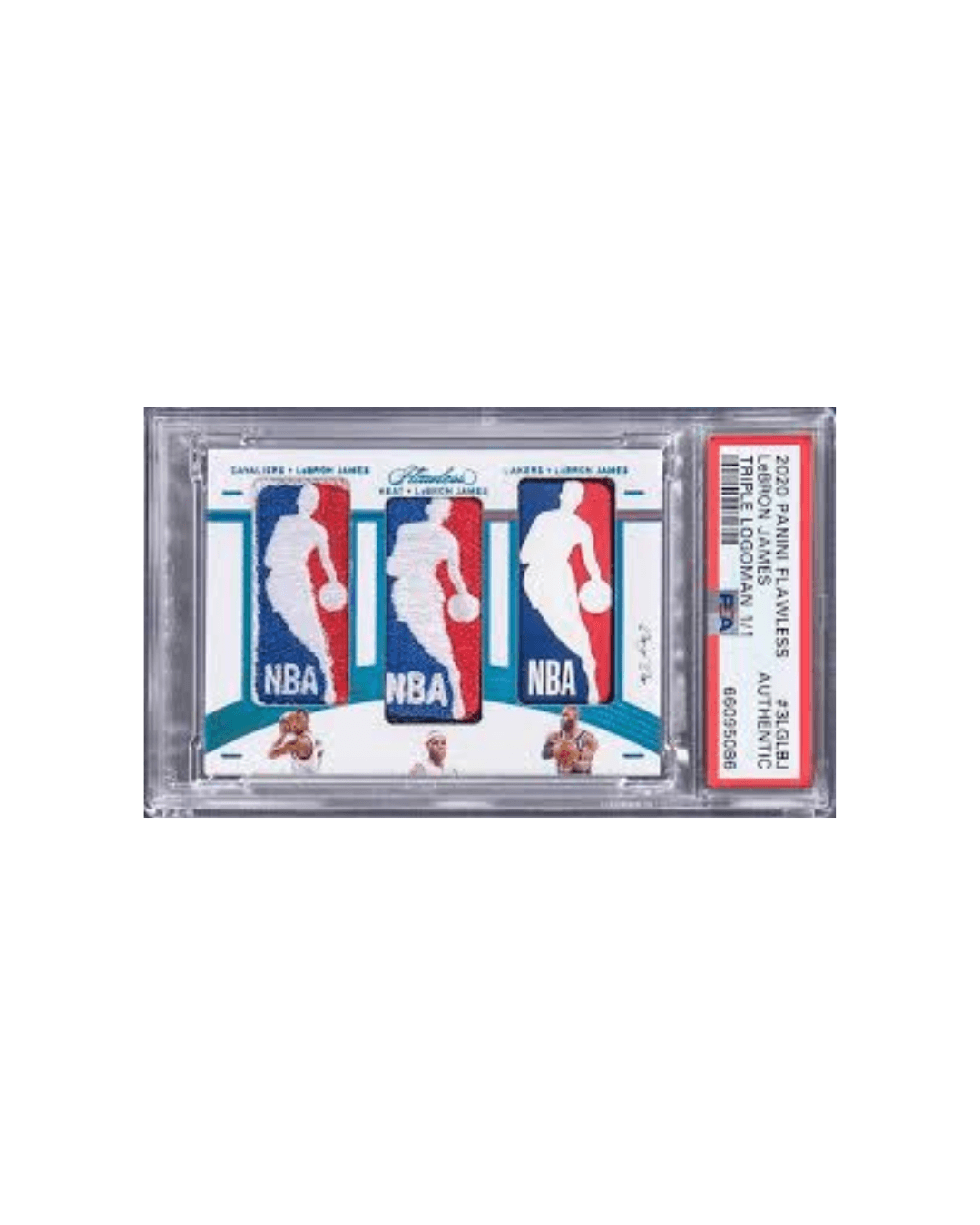
A Pikachu Illustrator PSA 10 sold for $16.49 million in February. A Kobe-Jordan Dual Logoman hit $12.9 million last August. Ohtani's MVP Logoman 1/1 went for $3 million. Paul Skenes' Debut Patch Auto 1/1 PSA 10 crossed $1.11 million on Fanatics Collect. LeBron's 2003 Topps Chrome Gold Refractor PSA 10 hit $1.1 million the same week.
At the Goldin 100 on March 7, Cooper Flagg's Padparadscha 1/1 sold for $366,000. Wembanyama's Superfractor 1/1 went for $488,000. Neither was a surprise. Both were confirmations that the high end has decoupled from the rest of the hobby entirely.
In 2021, a million-dollar card sale made headlines for a week. In 2026, it barely makes it past Tuesday.
The Bottom Arm: 1.26 Million Copies of Nothing
Now look down.
2025 Topps Update printed 228 million cards. That's 39.8% more than the year before. Fanatics/Topps NBA products pushed 429 million cards into the market. Each base card exists in roughly 1.26 million copies.
Matas Buzelis averaged $428.20 per card. Now he's at $168. A 60.76% drop. He's not injured. He's not a bust. He's a young player on a rebuilding team whose cards got buried under a print run calibrated for a speculation boom that ended three years ago.
Sam Darnold dropped 27% after the Super Bowl. The hype window opened, the hype window closed, and 27% of his value walked out with it.
The Junk Wax 2.0 comparisons aren't hyperbole anymore. When a base card has over a million copies, it's not a collectible. It's packaging.
Why 2021 Was Different
The 2021 boom was a pandemic party. Stimulus checks, boredom, zero interest rates, and a Reddit-fueled belief that everything scarce would go up forever. It was an everything rally. First-time flippers bought anything with a rookie label and expected returns.
2026 is institutional. Anthony Scaramucci's son is spending $16 million on single cards and pitching collectibles as an asset class on CNBC. Kevin O'Leary is wearing a $20 million card around his neck at the SAG Awards. Heritage Auctions closed 2025 above $2.15 billion. Goldin, Fanatics Collect, and Card Ladder have built the infrastructure that 2021 didn't have.
The money is smarter this time. It's also more concentrated. The whales buying $500K Wembanyama slabs are not the same people ripping retail at Target hoping to pull a base rookie worth $2.
In 2021, a rising tide lifted all boats. In 2026, the tide is lifting yachts and sinking dinghies.
The Sport-by-Sport Split
The K-shape plays out differently depending on the sport.
Baseball is riding Ohtani and prospect heat. Konnor Griffin's 1st Bowman Refractor hit $312, up 60% since January. Griffin hasn't played an MLB game yet. He's 19. Roki Sasaki showing up in Bowman's Best added another layer of prospect speculation to a market that already runs on it.
Basketball is Flagg, Wemby, and Cade Cunningham. Cunningham's Silver Prizm Rookie is up 88% in 30 days. Two years ago, collectors had written him off. Now the Pistons are winning and his cards are repricing his ceiling in real time.
Football is bracing for the end of Panini's NFL license. Last-run Prizm and National Treasures are carrying premiums because the market knows they're the final ones. Kenneth Walker III's PSA 10 Prizm is up 18% post-Super Bowl. Performance still pays.
But in all three sports, the base card market is the same story. Too many cards. Not enough demand. No floor.
The Warning Signs Nobody Wants to Hear
Pace projections assume the pace holds. It might not.
Macro risk is real. If unemployment ticks up or inflation forces the Fed's hand, discretionary spending on cardboard is the first thing to go. PSA just raised prices again. That adds friction at every level of the hobby.
There's also survivorship bias baked into every record-pace headline. The 7,025 sales above $10K are real. But they represent a tiny fraction of total transactions. For every Flagg 1/1 that sells for six figures, there are thousands of mid-tier parallels that moved sideways or down.
The top is running harder than ever. The bottom has more product than ever. And the distance between them is growing every month.
The New Reality
The sports card market in 2026 is not a sequel to 2021. It's a different movie with a bigger budget and a smaller cast.
The collectors and institutions at the top are spending record money on record cards. Everyone else is sorting through a mountain of overproduced cardboard hoping to find something that isn't already worthless. Both things are true. Both things define the hobby right now. The only mistake is pretending they're the same story.